The formula
What this step is, in one shape
A logline is twenty-five words with a named structure. A five-beat short is five named beats. You get the shape before you are asked to fill it.
Learn filmmaking by making a film
11 steps from the idea in your head to a short film that is finished, formatted and ready to submit.
Not a course to watch. A desk that walks you through it: every step explains the craft, gives you the formula, shows a worked example, asks you the questions, and checks what you wrote before it lets you on. A real feature is taken apart beside you so you can see what the finished thing looks like. By the end you have a script, a schedule, a budget and call sheets — the paperwork a unit actually shoots from.
Continue with Google See the 11 steps
Invite-only during launch. Sign in and ask for an invite, or buy a plan and come straight in. The learning library and the complete Dragon sample film are free, always — no card, nothing to install.
Signing in means you accept the Terms of Service and the Privacy Policy.
The tour
Launch price
Today’s figure is the launch price. It rises on a date held by the server, or once the launch seats are taken — whichever comes first.
Continue with Google See the plans
Nothing here resets. The rise is scheduled on the server and fires by itself, so reloading this page shows you less time, never more.
Start here
A short is the right first film: one location, one want, one obstacle, and a running time you can actually finish. These are the steps, in order, each with its own page in the studio. Nothing is locked behind the one before it — but they are in this order because this is the order that works.
Every short begins with one indivisible thing. An image. A moment.
one evening
A short film logline is even tighter than a feature's. Twenty-five words or less.
two evenings
One protagonist. One want. One obstacle. That's all the runtime allows.
two evenings
Forget the 15-beat feature structure. A short has five: Setup, Disturbance, Escalation, Turn, Image.
two evenings
For a short, the world is usually one location, one time of day, one weather.
one evening
Most shorts work with 5 to 12 scenes. List them before you write a line of dialogue.
two evenings
Now write the actual screenplay. The structured editor below formats your slugs, action, and dialogue automatically.
5-10 sessions
Live preview of your script in proper screenplay format, plus export to Fountain (universal screenplay markdown that any pro app can open).
one evening
Most shorts shoot in 1–4 days, with 3–6 crew, in 1–3 locations. Knowing your reality before you finalize the script lets you cut what you can't actually shoot.
two evenings
A short film is a calling card. Festivals are how it gets seen. Strategy: pick 12–20 festivals across three tiers, submit early, never online-premiere before a top-tier rejection.
one evening
Read aloud, double-check, and lock. After this, the script doesn't change unless you discover something on set.
30 min
Then the long one: the feature blueprint runs to 24 steps, in the same shape, for when the short is behind you.
What is actually taught
The thing missing from a blank page is not a text editor. It is somebody telling you what this step is for, what good looks like, and whether what you just wrote is finished. Each of the 11 short steps and the 24 feature steps carries all five of these.
The formula
A logline is twenty-five words with a named structure. A five-beat short is five named beats. You get the shape before you are asked to fill it.
The why
What a festival selector does with your logline, what happens on set when the scene map is vague — the consequence, not the rule.
Worked examples
Finished examples to read before you write, so “good” is something you have seen rather than something you are guessing at.
The questions
Instead of an empty box, a short list of questions. Answer them and the step has written itself.
The check
A checklist you tick, so “finished” is a decision you made rather than a feeling you had at midnight.
The library
4 Tamil films broken down beat by beat, 122 craft terms in plain words, and a reference shelf of 22 films to watch with a purpose.
Free, always
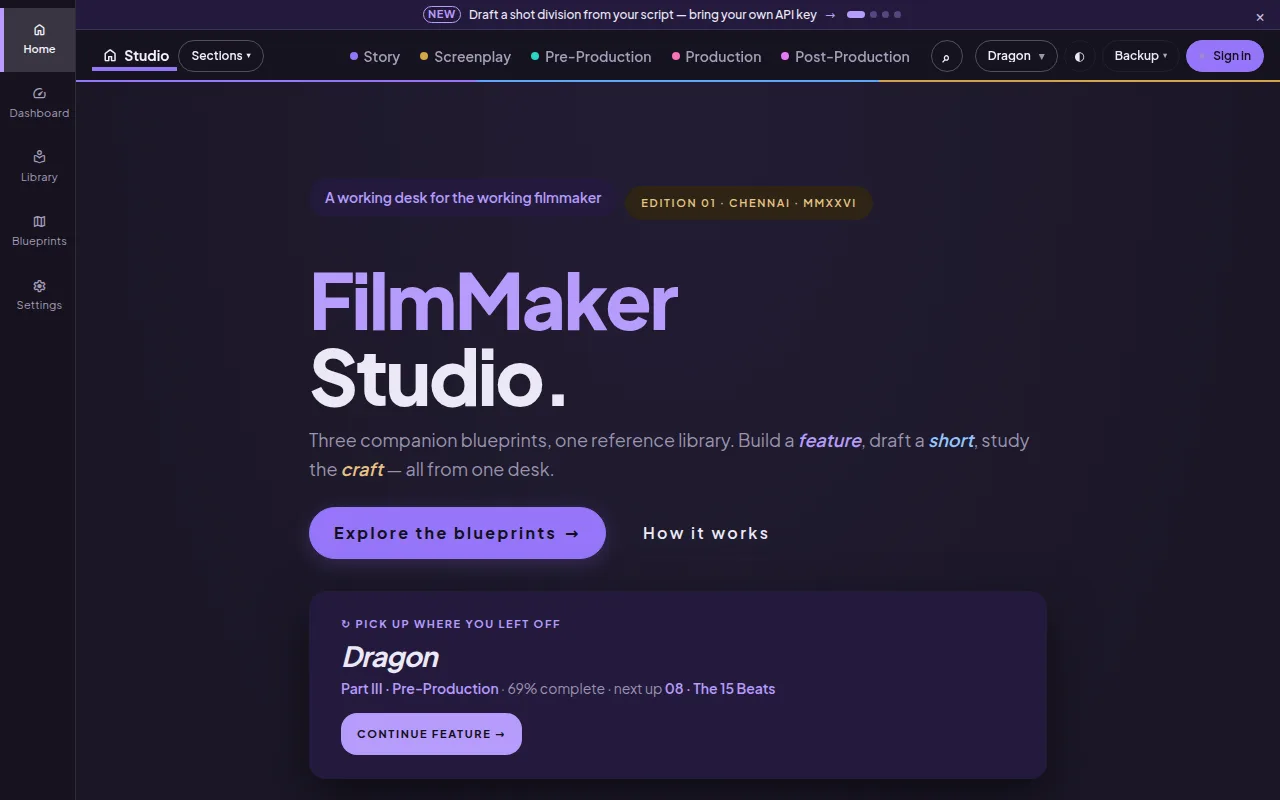
An empty desk teaches nobody anything. The studio opens on a complete feature instead: Dragon (2025, dir. Ashwath Marimuthu) reconstructed as a production — a full 36-scene screenplay of 105 pages, the scenes broken down from it, a schedule of 18 shoot days across 17 locations, a 29-person unit, a budget and two call sheets. Open any of it, change any of it, break any of it. It is the answer sheet for every step on this page.
The public facts are credited and correct. Every piece of paperwork — the schedule, the dates, the budget, the unit, the recces, the call sheets and every line of the script — is invented for the demonstration and says so wherever it appears. No real person’s contact details and none of the film’s actual screenplay are in it.
And then the film gets made
Everything you write becomes the next thing you need. There is no second document to keep in step, because there is no second document.
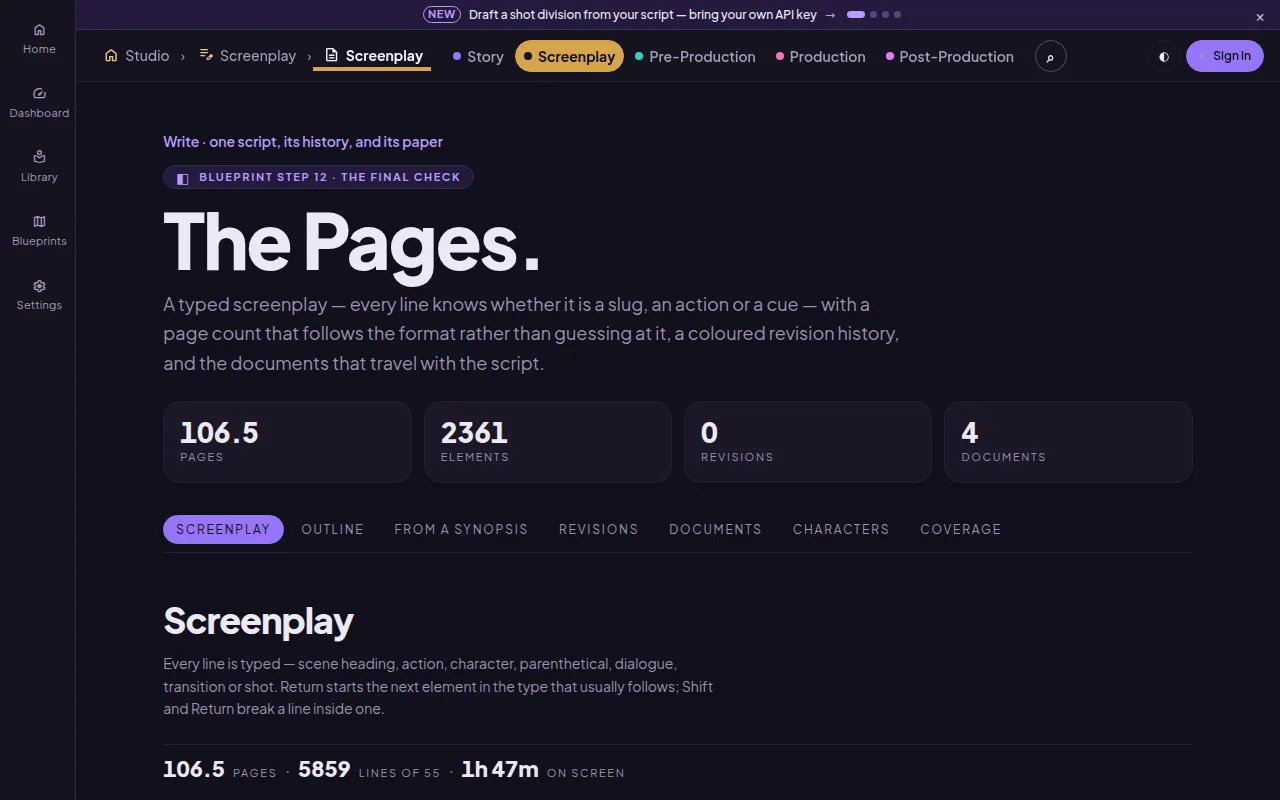
1
A screenplay editor that formats as you type — slug lines, action, cues, dialogue, dual dialogue — and keeps
the page count honest. Tamil, Tanglish or English. Import a .fountain, .fdx or PDF; export a properly
paginated screenplay PDF.
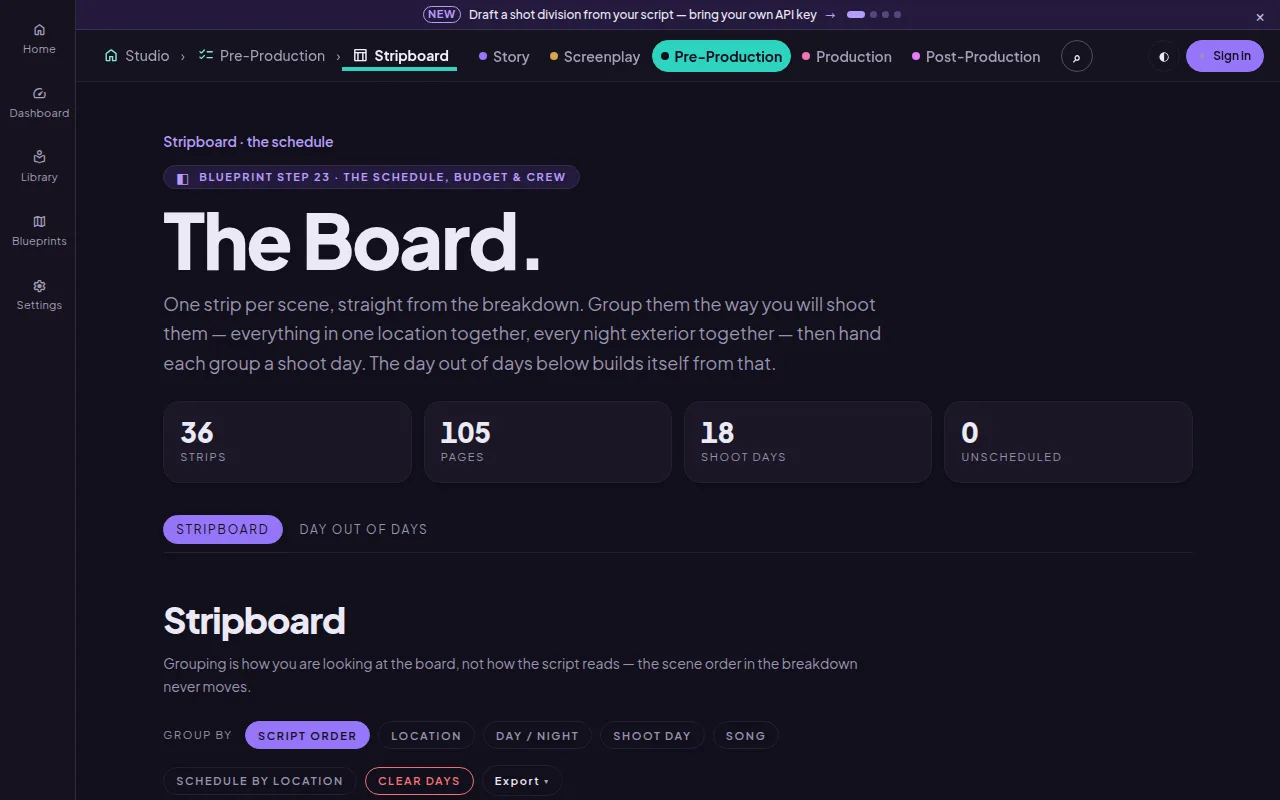
2
Every scene heading becomes a scene row. Break it down into cast, props and vehicles, lay the strips out into shoot days, see the day out of days and the locations, and price it at Chennai rates — all from one scene model, so nothing is typed twice.
3
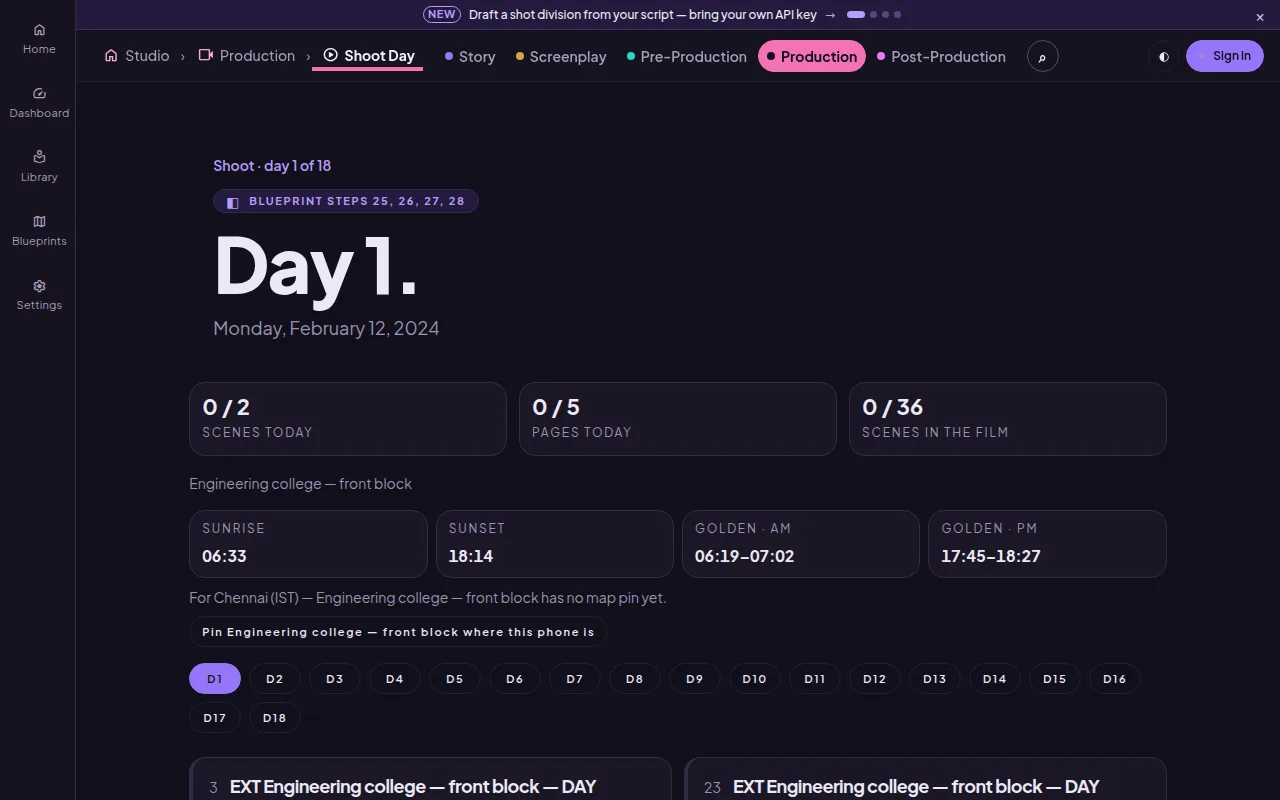
The shoot day on a phone: today’s scenes, who is called, sunrise and golden hour for the location, and what you actually got — shot, part or dropped. The edit log reads those marks to say what is in the can.
Made here
The craft is the same everywhere. The paperwork is not. These are the six things an imported tool makes you work around.
Call sheets laid out to be sent as a message the unit will actually read, not a PDF nobody opens.
Dialogue in Tamil script or Tanglish with slugs in English, and a page count that says when it is an estimate.
Crew bata and daily rates in one table that feeds the budget, so a schedule change moves the money.
A deliverables checklist for the censor copy, the DCP and the festival and OTT formats, ticked off against the cut.
Budget lines at Chennai market rates — shown as a band with the date each figure was last checked, never a guess dressed as a fact.
Sun times for each location and day, so the schedule respects the light.
The whole desk
The studio is arranged the way a film is made, from the idea to the screening. Each stage is a set of modules, and every module reads the same film — the script, the scenes, the people, the days — so a change in one place shows up in all of them.
Everything is bound to a project. Open a film and its dashboard shows where it is, stage by stage, with the next thing to do and every module for that film one click away.
Pricing
There is no subscription. A plan is bought once with full-time access, and never renews or lapses. Prices are in Indian rupees, paid through Razorpay. Price confirmed at checkout.
Recommended for a first film
Basic₹599Your own films: the 11 steps, the screenplay, the breakdown and the exports.Buy Basic| What you get | Free | Basic | Intermediate | Pro |
|---|---|---|---|---|
| Learning library & blueprints | Included | Included | Included | Included |
| Your own films | Not included | Included | Included | Included |
| Screenplay editor, revisions | Not included | Included | Included | Included |
| Script import and exports | Not included | Included | Included | Included |
| Breakdown, scene list, shot list | Not included | Included | Included | Included |
| Stripboard, day out of days, calendar | Not included | Not included | Included | Included |
| Budget at Chennai rates | Not included | Not included | Included | Included |
| Call sheets and the shoot day | Not included | Not included | Included | Included |
| Google Drive backup | Not included | Not included | Included | Included |
| AI tools (your own key) | Not included | Not included | Not included | Included |
| Edit log and deliverables | Not included | Not included | Not included | Included |
Prices are one-time list prices, confirmed at checkout. Local work and the learning library are on every plan. A higher plan can be had later by paying the difference.
Subscription tools charge every month for as long as you keep making films. Here you pay once and the desk is yours.
Invite-only during launch: sign in to ask for an invite, or buy a plan above and come straight in.
Checkable, not claimed
11
Each with a formula, a reason, worked examples, the questions to answer and a check that it is done.
24
The same shape at feature length, for the film after this one.
4
Case studies you can read against your own structure, not summaries.
122
What a unit actually means by them on the day, not a dictionary.
36
A complete reconstructed production — script, schedule, budget, call sheets — free to open and edit.
22
What to watch next, and what to watch it for.
When there are real users with real films, their words will appear below this — with their written consent on file, their name, and the date they gave it. Not before.
Made with it
Questions
It is built for exactly that. The 11-step short blueprint assumes you know nothing and explains each step before it asks you for anything — what a logline is and why twenty-five words, what a beat is, why a short has five of them and a feature has more. The 122 terms in the library are there for the moment somebody says “we’ll pick it up in the edit” and you need to know what that means.
No. Everything on this page happens before a camera is switched on: the idea, the logline, the character, the structure, the scenes and the script. When you do get to the shoot, the studio tells you what a day of it would cost at Chennai rates, which is usually the moment the film becomes a plan instead of a wish.
No, and you will not have to learn any. The editor formats as you type: start a line with INT. and it is a
slug line, type a name in caps and the next line is dialogue. Nothing to configure, no template to download, and the page
count is the industry one. If you already have a script, import a .fountain, .fdx or PDF.
Free, always: the whole learning library and the complete Dragon sample film, which you can open and change with no card and nothing installed. Your own films need a plan. While the studio is invite-only you can sign in and ask for an invite, which may come with a free trial; an invite code is worth seven days of the whole studio. Or buy a plan and come straight in. Either way, everything you write stays yours and can be exported.
That is the commonest first film there is, and the paperwork is the part nobody teaches. A short blueprint you can hand to a guide, a schedule and a call sheet your unit can read, and a budget at real rates will get you further with a department than a good idea will.
Yes. Dialogue in Tamil script or in Tanglish, with slug lines and action in English — the arrangement most Tamil units shoot from. Tamil throughout is offered too, with the page count labelled an estimate.
It installs as a web app and every page opens from the device with no connection; your writing is saved to the browser as you type. The other side of that is real: work that was only in that browser goes when the browser is cleared. Export a backup file now and then, or connect Google Drive once and forget about it; signed-in films come back from the cloud on the next sign-in.
On your device, in this browser’s storage, unless you choose otherwise. Your script stays on your machine. Sign in with Google and your films can also sync to the studio’s cloud, where row-level security keeps each account’s rows to itself; connect Google Drive and a backup file sits in your own Drive. Export the whole studio as one file whenever you like. The Privacy Policy lists exactly what is collected and why.
Yes. Pay the difference between your plan and the higher one and you are upgraded; nothing you made is touched.
You are covered, in full, to the card, UPI, net banking or wallet you paid with, if you were charged twice or by mistake, if you paid and the plan was never delivered (or we activate it, your choice), or wherever Indian law requires a refund. Otherwise a plan is final, which is why the learning library and the Dragon sample are free to try first — and on any plan you can export all your work whenever you like. The Refund & Cancellation Policy has the detail and the address to write to.
Leave your e-mail and we will write when there is an offer worth knowing about or a new step in the library. Nothing else.
This page counts visits in aggregate (a number per day, nothing about you) and honours Do Not Track.
Find the one thing your film is about. The studio asks you four questions and you are past it.
Continue with Google See pricing
Signing in means you accept the Terms of Service and the Privacy Policy.